Software
Here are the tools we have developed or contributed to. Many are designed to make microscopy and image analysis easier to run, reproduce and share. Looking for example data or trained models? See our datasets, models and materials.
NucleiSky (2026)
NucleiSky registers microscopy images in 2D and 3D by matching the spatial arrangement of segmented nuclei. It can align partial fields of view, regions of interest or tissue subvolumes to larger reference images without relying on pixel-intensity similarity. It can be used through Google Colab, a desktop interface or directly from Python.

LabConstrictor (2026)
LabConstrictor turns Jupyter notebooks into installable desktop applications. It lets researchers share notebook-based analysis workflows with users who do not have Python, pip or a terminal set up. Projects remain versioned and reproducible, while LabConstrictor handles packaging, cross-platform installers and the application interface.
EZInput (2026)
EZInput is a Python library for building simple interfaces for scientific computing workflows. Inputs are defined once and can then be used across Jupyter notebooks, Google Colab and terminal applications. It supports validated inputs, saved sessions and shareable parameter files, making computational workflows easier to run repeatedly with consistent settings.

Rxiv-Maker (2025)
Rxiv-Maker is a framework for writing scientific manuscripts in Markdown and generating publication-ready outputs. It handles citations, figures, LaTeX typesetting, executable code blocks, DOCX export and preprint submission packages. The aim is to keep manuscripts, figures, data-derived results and version history in sync throughout the writing process.
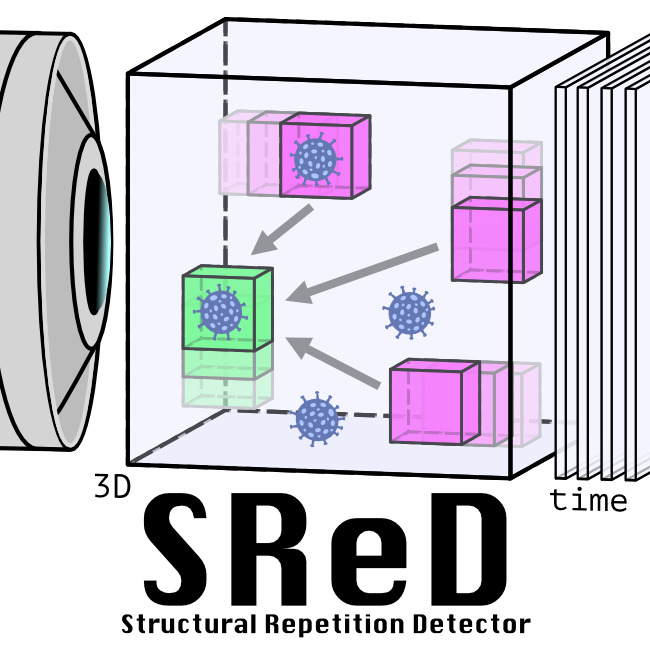
SReD (2025)
SReD, the Structural Repetition Detector, is an ImageJ/Fiji plugin for detecting repetitive structures in microscopy images. It measures local structural similarity to generate maps of recurring patterns across different spatial scales. The method does not require labelled training data and applies to a range of biological structures and imaging modalities.
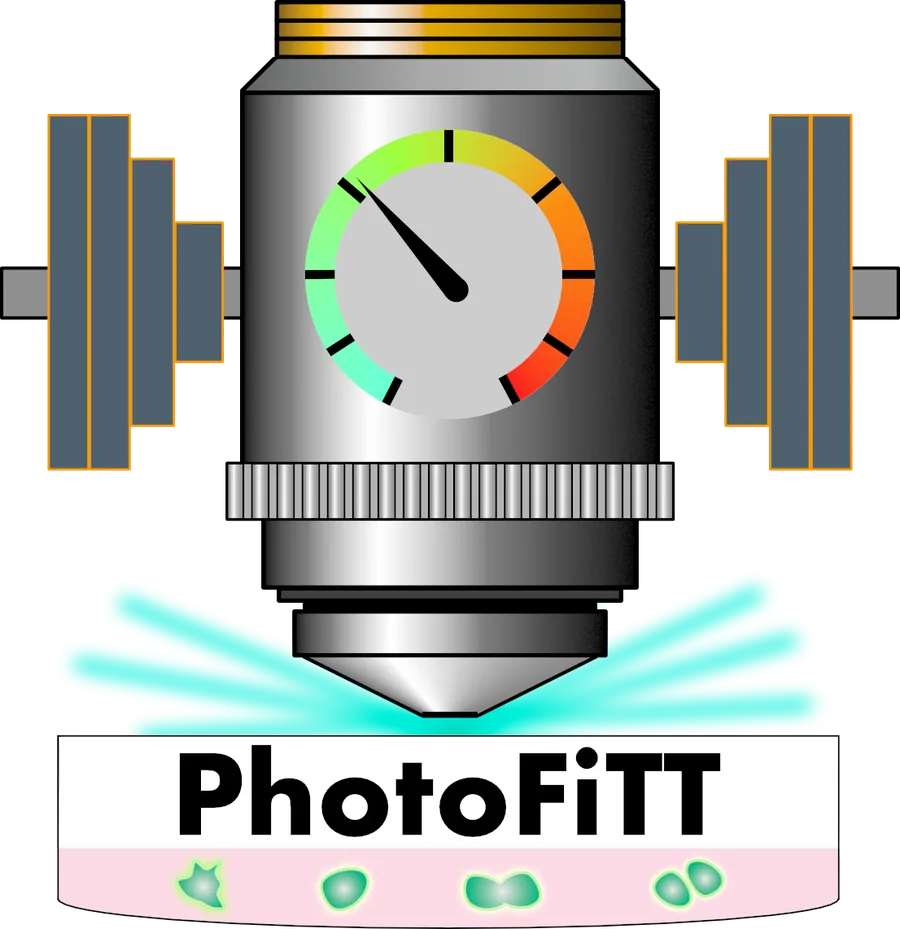
PhotoFiTT (2024)
PhotoFiTT measures phototoxicity during live-cell microscopy. It combines a standardised imaging protocol with image analysis that quantifies changes in mitotic timing, cell size and cellular activity after light exposure. The framework helps compare imaging conditions and identify settings that preserve cell health while still producing useful images.
CellTracksColab (2024)
CellTracksColab brings tracking data from multiple movies, conditions and experiments into a single analysis workflow in Google Colab. It can be used to inspect individual tracks, compare conditions, analyse movement and spatial relationships, and explore high-dimensional tracking features using dimensionality reduction and clustering. The notebooks make these analyses accessible without requiring users to build an analysis pipeline from scratch.
NanoPyx (2024)
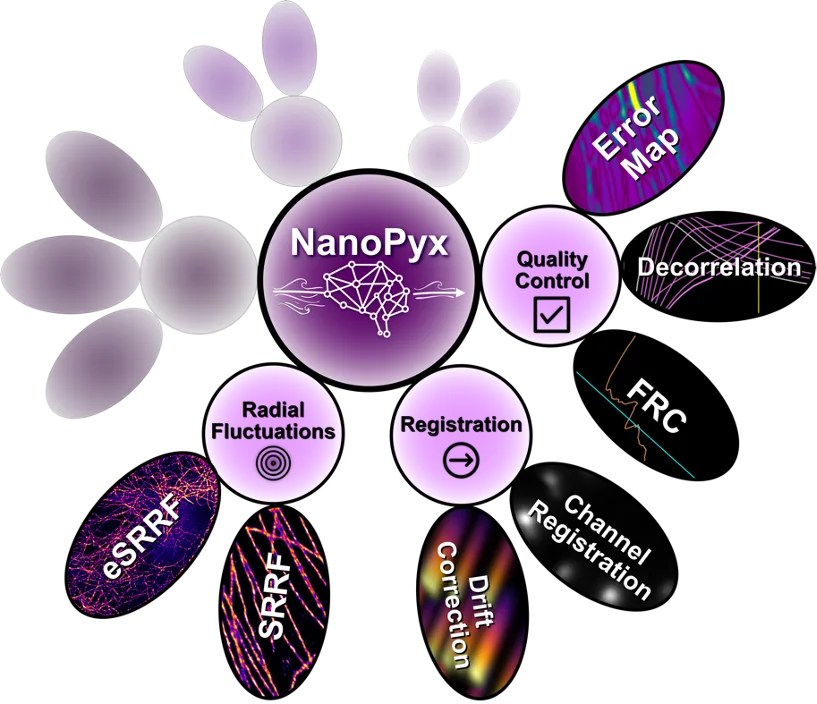
NanoPyx is a Python library for analysing light-microscopy and super-resolution images. It builds on methods originally developed in the NanoJ ecosystem and includes tools developed by the Henriques Laboratory and collaborators.
DL4MicEverywhere (2024)
DL4MicEverywhere makes deep-learning workflows for bioimage analysis portable across different computing environments. It provides interactive Jupyter notebooks with graphical interfaces and uses Docker containers to reproduce the required software environment. Workflows can run on laptops, workstations, high-performance computing systems or cloud infrastructure. DL4MicEverywhere extends ZeroCostDL4Mic beyond Google Colab while keeping the notebook-based interface.
eSRRF (2023)
eSRRF is a fluorescence-fluctuation method for super-resolution microscopy. It reconstructs higher-resolution images from image sequences and includes tools for selecting reconstruction parameters. The parameter-selection approach helps users balance resolution, image quality and reconstruction artefacts across different datasets.
Fast4DReg (2023)
Fast4DReg is a Fiji plugin for correcting drift in 2D and 3D time-lapse microscopy datasets. It uses intensity projections and cross-correlation to estimate displacement along the x-, y- and z-axes, then corrects each frame. It can also align channels in multichannel 2D and 3D datasets.
TrackMate (2022)
TrackMate is a Fiji plugin for detecting and tracking objects in microscopy images. Our work has helped extend TrackMate to modern segmentation methods, including machine-learning and deep-learning detectors such as StarDist, and to workflows for tracking cells and subcellular structures.
ZeroCostDL4Mic (2021)
ZeroCostDL4Mic provides notebook-based deep-learning workflows for microscopy that can run in Google Colab without local software installation. The notebooks cover common bioimage-analysis tasks including segmentation, denoising, restoration, super-resolution and image-to-image translation using established deep-learning models.
FiloMap (2019)
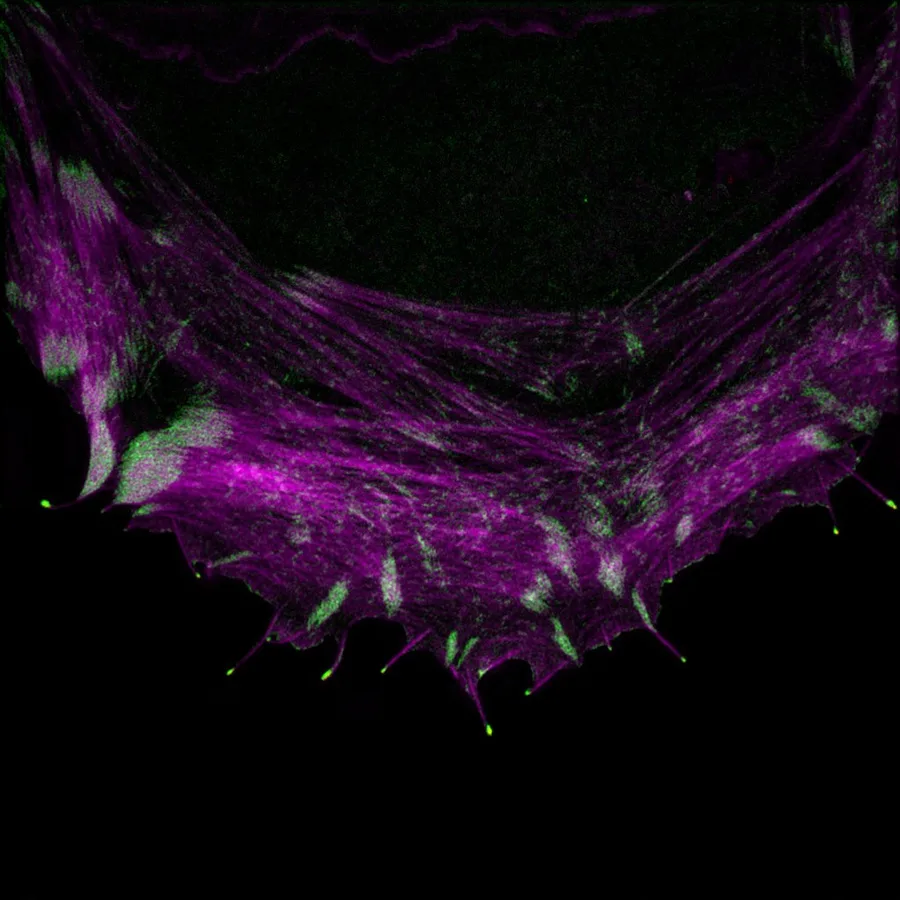
FiloMap consists of ImageJ and R scripts for measuring where proteins localise along filopodia. The accompanying protocols describe how to generate filopodia maps and compare the localisation patterns of multiple proteins.
FiloQuant (2017)
FiloQuant is a Fiji plugin for detecting and measuring filopodia in microscopy images. It measures properties including filopodia number, length and density. A step-by-step methods chapter describes workflows for analysing both isolated filopodia and filopodia-like structures in more complex samples.